Conjunction (Basic ㊦ 179)
A subordinate conjunction which expresses a reason or a cause.
Equivalent: So; since; because
| Sinformal | から | |
| {話す/話した}から | Because someone (will) talk/talked | |
| {高い/高かった}から | Because something is/was expensive | |
| {静かだ/静かだった}から | Because somehing is/was quiet | |
| {先生だ/先生だった} から | Because someone is/was a teacher |
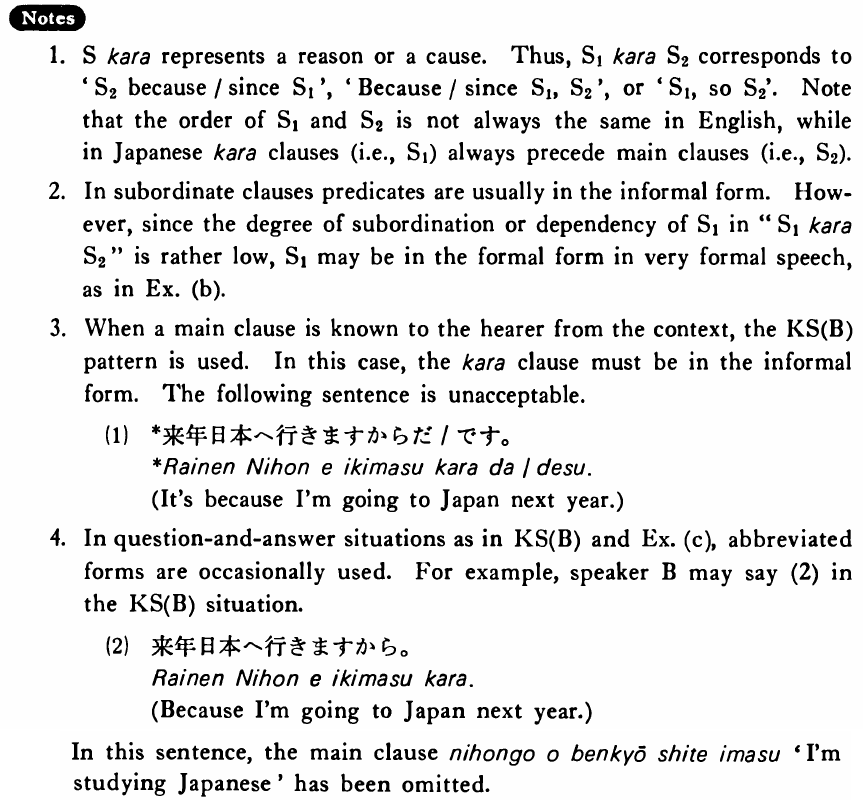
1. Sentence から represents a reason or a cause. Thus, Sentence1 から Sentence2 corresponds to 'Sentence2 because/since S1', 'Because/since Sentence1, Sentence2', or 'Sentence1, so Sentence2'. Note that the order of Sentence1 and Sentence2 is not always the same in English, while in Japanese から clauses (i.e., Sentence1) always precede main clauses (i.e., Sentence2).
2. In subordinate clauses predicates are usually in the informal form. However, since the degree of subordination or dependency of Sentence1 in "Sentence1 から Sentence2" is rather low, Sentence1 may be in the formal form in very formal speech, as in Example (b).
3. When a main clause is known to the hearer from the context, the Key Sentence (B) pattern is used. In this case, the から clause must be in the informal form. The following sentence is unacceptable.
4. In question-and-answer situations as in Key Sentence (B) and Example (c), abbreviated forms are occasionally used. For example, speaker B may say (2) in the Key Sentence (B) situation.
In this sentence, the main clause 日本語を勉強しています 'I'm studying Japanese' has been omitted.